The short answer
The cell-membrane and transport ideas that drive a steady stream of Section III biology.
Written and checked by GAMSAT tutors — not AI-generated.
Try the reasoning style
We treat forgetting as a failure — a lapse to be patched with reminders and records. Yet a mind that kept everything could not think; it would drown in the undifferentiated noise of every moment it had ever lived. To forget is not so much to lose information as to decide, mostly without our noticing, what was never worth keeping.
The author's argument relies most directly on which unstated assumption?
Pick an option to see how the tutor reasons to the answer — not just whether you were right.
Not quite — the answer is B.
Work backwards from the conclusion: a mind that ‘kept everything’ supposedly ‘could not think.’ That only follows if thinking means leaving most of experience out — so B is the premise the argument quietly rests on. A raises reliability, which the passage never weighs; C contradicts ‘mostly without our noticing’; D smuggles in a claim about intellect the passage never makes. The question rewards finding the hidden premise, not recalling a fact.
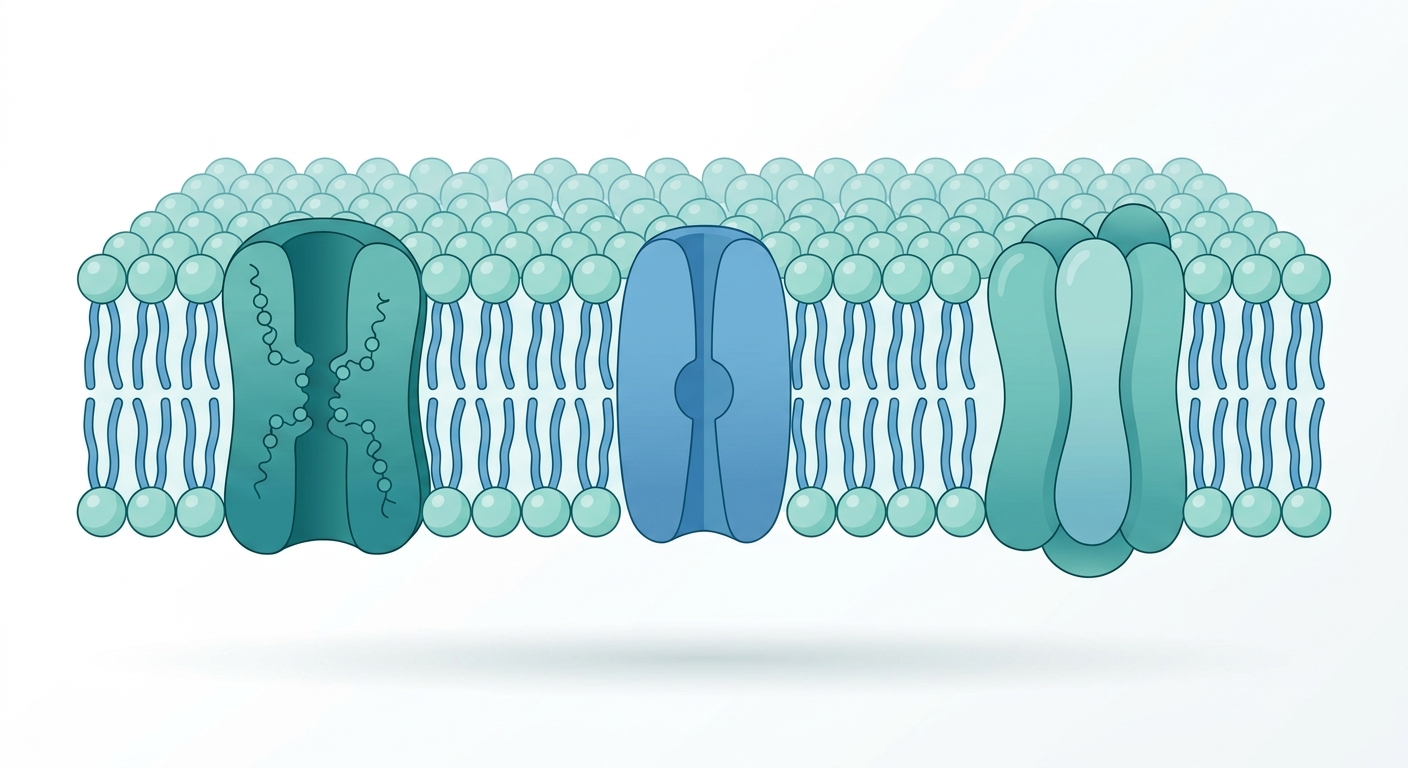
Most Section III cell-biology questions come back to one structure — the membrane — and how things cross it. Get this and you can reason through unfamiliar scenarios.
Why the structure matters
The bilayer is selectively permeable: small non-polar molecules (O₂, CO₂) slip through easily, but ions and large polar molecules need protein channels or carriers. That single fact explains most transport questions.
Passive vs active transport
Passive (no ATP)
- Moves DOWN the gradient (high → low)
- Diffusion, osmosis, facilitated diffusion
- Spontaneous — no energy needed
- Stops at equilibrium
Active (needs ATP)
- Moves AGAINST the gradient (low → high)
- Pumps, e.g. the Na⁺/K⁺ pump
- Requires energy (ATP)
- Can maintain a steady imbalance
Check yourself
A cell keeps its internal K⁺ concentration far higher than the fluid around it. Which process must be involved?
Key takeaways
- The membrane is a selectively permeable phospholipid bilayer (fluid mosaic).
- Small non-polar molecules cross freely; ions and polar molecules need proteins.
- Passive transport follows the gradient and needs no energy.
- Active transport goes against the gradient and costs ATP.
Practise this with real GAMSAT-style questions
Free account: a timed diagnostic, an AI tutor that explains every answer, essay marking on the official rubric, and a plan built around your weak spots.